
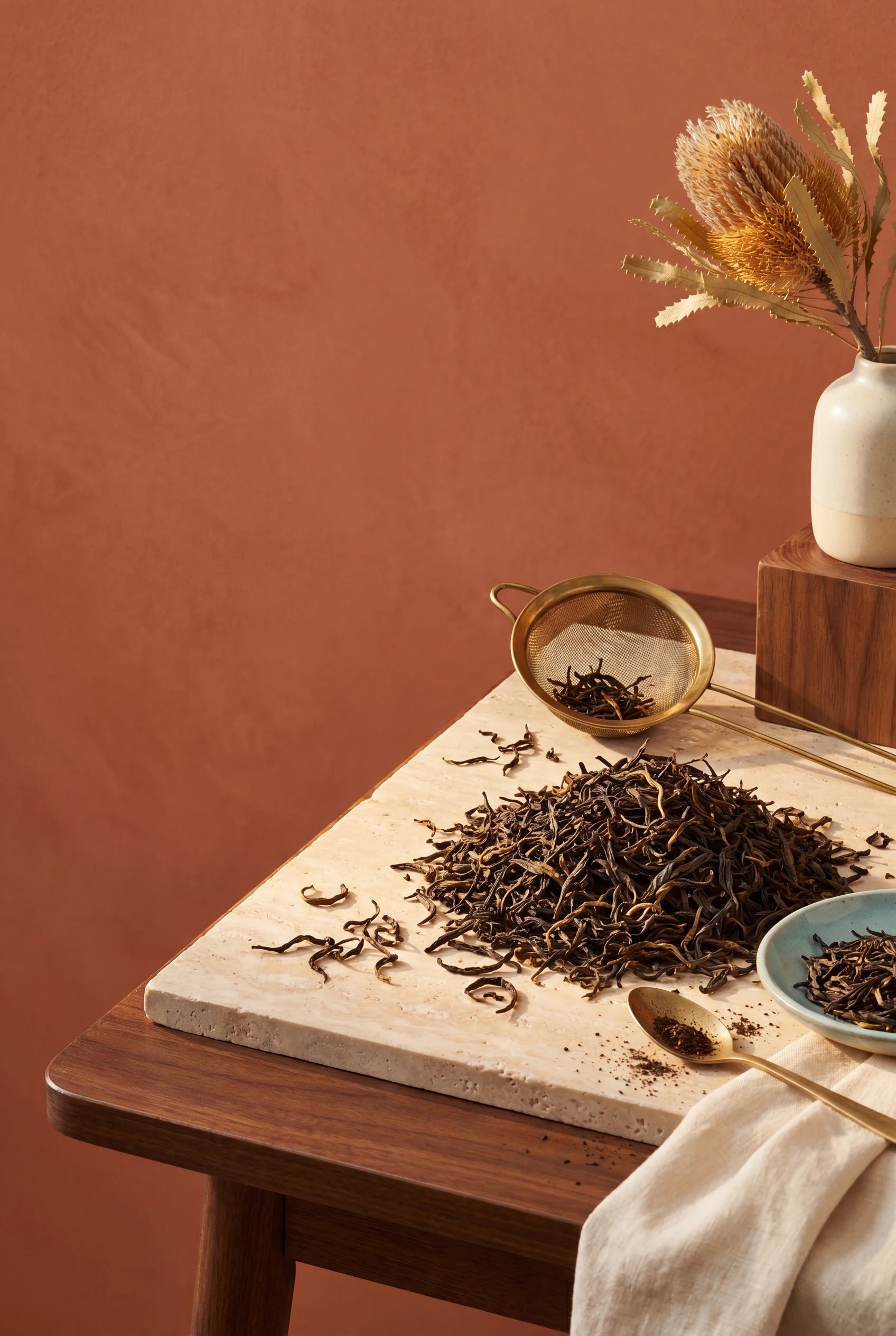
Ceylon black tea
Camellia sinensis
Bright and brisk, and rich in theaflavins, the antioxidants formed when tea leaves oxidise. Its caffeine comes paired with L-theanine for a calm, steady lift (Camfield et al., 2014).
Black tea benefits
An honest look at the evidence for black tea, its theaflavins and its calm-focus caffeine, in a smooth organic blend
Black tea is fully oxidised green tea, rich in theaflavin antioxidants, with research interest in heart health and a modest cholesterol effect, plus the calm-focus lift of caffeine paired with L-theanine. Sippo Slow Mornings blends organic Ceylon and Assam black teas with white tea and rose. Honest framing: a genuinely good daily cup with modest, well-studied benefits, not a medicine.
Black tea is the everyday tea most of the world drinks, and it quietly has solid research behind it: antioxidants, a modest heart and cholesterol interest, and the calm, steady lift that comes from caffeine paired with L-theanine. Slow Mornings is our smooth Ceylon and Assam blend, and this is the honest account of what black tea does.
The pick

smooth breakfast tea
How it compares
| What the research supports | Sippo Slow Mornings | Conventional |
|---|---|---|
| Theaflavin antioxidants | Yes, from oxidation | Sometimes exaggerated |
| Research interest in heart health | Yes, modest (Hartley) | Sold as a cure |
| Modest cholesterol effect | Yes, small (Zhao) | Framed as a statin swap |
| Calm-focus caffeine with L-theanine | Yes (Camfield) | Overblown as a nootropic |
| A smooth, satisfying daily cup | Yes | Not in doubt |
| Certified organic, real leaves | Yes | Often dust |
What's inside, and why

Camellia sinensis
Bright and brisk, and rich in theaflavins, the antioxidants formed when tea leaves oxidise. Its caffeine comes paired with L-theanine for a calm, steady lift (Camfield et al., 2014).

Camellia sinensis
Deep and malty, for body and a satisfying cup. A meta-analysis found black tea was associated with a modest reduction in LDL cholesterol, mainly in higher-risk groups (Zhao et al., 2015).
Camellia sinensis
The least processed tea, adding a delicate softness and its own catechin antioxidants, keeping the blend smooth rather than harsh.

Rosa damascena
A soft floral finish that makes a daily black tea feel like a considered ritual rather than just a caffeine delivery system.
How it adapts
| Target | How it solves it | Key ingredient | What you'll notice |
|---|---|---|---|
| Curious about black tea benefits | An honest read of the antioxidant and heart research | Theaflavins | Clear, measured information |
| Wanting a smooth daily cup | Ceylon and Assam balanced with white tea | The blend | Full but never bitter |
| A calm, steady lift | Caffeine paired with L-theanine | Black tea leaf | Awake without the jitters |
| Avoiding overhyped claims | We separate evidence from marketing | Honest framing | No cure or statin claims |
| Wanting real leaves | Cut leaves in a pyramid bag, not dust | Organic blend | A proper, full brew |
Outside-in routine pairings
Black tea handles the morning cup from the inside. Mint Condition handles the morning shower from the outside.

matcha mint body scrub
Mint Condition is our matcha mint body scrub, with a cooling peppermint tingle that wakes the body up. A smooth black tea and a fresh morning shower, the inside and outside of a good start.
See Mint ConditionPeople also ask
Black tea is rich in theaflavin antioxidants formed during oxidation, has a research interest in cardiovascular health (Hartley et al., 2013), and a meta-analysis found a modest LDL-cholesterol reduction, mainly in higher-risk groups (Zhao et al., 2015). Its caffeine is paired with L-theanine for a calm, steady lift (Camfield et al., 2014). These are modest and well-studied, not miracle claims.
They are close cousins, black tea is simply fully oxidised green tea, which converts some catechins into theaflavins. Both have antioxidant and modest heart research behind them. Neither is a cure for anything, and the best one is the one you will actually drink daily.
A meta-analysis found a modest LDL reduction, with the effect strongest in people at higher cardiovascular risk and the size small overall (Zhao et al., 2015). So it is a research interest worth knowing, not a reason to skip medical advice or treatment.
A moderate amount, less than coffee. Because the caffeine comes with L-theanine, the lift tends to feel steadier than coffee's spike. Enjoy it morning to early afternoon.
Black tea, honestly
Black tea is the same plant as green tea, Camellia sinensis, simply allowed to oxidise fully after picking. That oxidation turns some of the green tea catechins into theaflavins and thearubigins, the compounds behind black tea's darker colour, fuller flavour and its own antioxidant profile. It is the everyday tea most of the world drinks, and it has quietly accumulated a respectable research base.
Black tea carries theaflavin antioxidants, has a research interest in cardiovascular health (Hartley et al., 2013), and a meta-analysis found a modest LDL-cholesterol reduction, strongest in higher-risk groups (Zhao et al., 2015). Its caffeine is paired with L-theanine, the amino acid behind tea's calm, steady focus (Camfield et al., 2014). These are genuine, modest findings, generally from regular consumption over time.
As with green tea, the temptation is to inflate these into cures, and we will not. The cholesterol effect is small, the heart research is an interest rather than a guarantee, and no tea replaces medical care. What is fair to say is that a daily black tea is a pleasant habit with some modest, well-studied benefits, which is a perfectly good reason to drink it without any exaggeration.
Slow Mornings uses Ceylon for brightness and Assam for body, the classic black-tea pairing, softened with a little white tea so it stays smooth rather than tipping into bitterness, and finished with rose for a considered touch. Real cut leaves in a pyramid bag mean a fuller, more generous brew. A proper daily black tea, honestly described, that you will actually look forward to.
Zhao, Y., Asimi, S., Wu, K., Zheng, J., & Li, D. (2015). Black tea consumption and serum cholesterol concentration: Systematic review and meta-analysis of randomized controlled trials. Clinical Nutrition, 34(4), 612-619. https://doi.org/10.1016/j.clnu.2014.06.003
Found a modest LDL-cholesterol reduction with black tea, mainly in higher-cardiovascular-risk groups. Effect size small (about 4.6 mg/dL); cited cautiously as research interest, not a treatment.
Hartley, L., Flowers, N., Holmes, J., Clarke, A., Stranges, S., Hooper, L., & Rees, K. (2013). Green and black tea for the primary prevention of cardiovascular disease. Cochrane Database of Systematic Reviews, 6, CD009934. https://doi.org/10.1002/14651858.CD009934.pub2
Cochrane review of tea and heart-health prevention. Findings are modest and about long-term habitual intake, not a single cup; cited honestly for general context, not a treatment claim.
Camfield, D. A., Stough, C., Farrimond, J., & Scholey, A. B. (2014). Acute effects of tea constituents L-theanine, caffeine, and epigallocatechin gallate on cognitive function and mood: A systematic review and meta-analysis. Nutrition Reviews, 72(8), 507-522. https://doi.org/10.1111/nure.12120
Pooled trials found L-theanine with caffeine improves attention and alertness, the pairing that occurs naturally in tea. Trial doses are standardised; tea delivers a gentler version of the same combination.
Keep exploring
Smooth Ceylon and Assam with modest, well-studied benefits, honestly described. Love it in 30 days or it's on us.
Shop Slow Mornings